

Table of Contents
The Whole Family Dotes On Her Korean Drama opens with pain rather than romance, and that choice gives the story much of its emotional pull. Instead of easing viewers into a sentimental reunion, it begins in the aftermath of sacrifice, separation, and a life hanging in the balance. What follows is a DramaBox story shaped by old love, family pressure, and the quiet damage left behind when people part without closure. Beneath the hospital corridors, tense confrontations, and rich family politics, this is really a melodrama about what happens when the past comes back asking to be seen.
A reunion story built on absence, not nostalgia
Some dramas rely on instant chemistry and fast-moving attraction. This one takes a different route. Its strongest emotional note comes from what has been lost. Fifteen years earlier, Oh Hee-seon gives a kidney to save SeungWoo Choi, the man she loves, then walks away when it becomes clear that love alone may not survive class divisions and family expectations. That history matters because the series never treats it as a small misunderstanding. It frames their separation as something shaped by sacrifice, pride, and social reality.
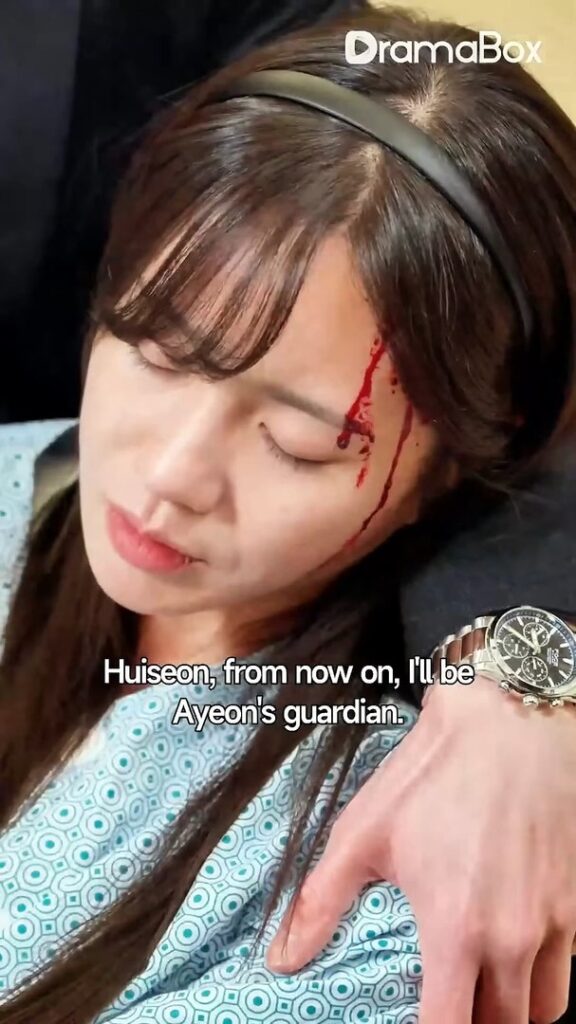
That choice gives the later reunion real weight. When the story returns to the present, it is no longer about young romance. It is about consequences. Hee-seon is no longer just the woman from a past love story. She is now a mother, a survivor, and eventually a patient lying unconscious after saving Koo Jun-hyun, the heir to the Gohyun Group. Her daughter, Ah-yeon Choi, becomes the emotional center of the series from that point forward.
The shift works well because the drama understands that time changes the meaning of love. What once looked like heartbreak now feels tied to guilt, memory, and unfinished responsibility. That is what gives this family melodrama its reflective edge.

The hospital scenes give the drama its emotional core
The best stretch of The Whole Family Dotes On Her DramaBox is set around the hospital, where the story tightens emotionally without becoming overly theatrical. Ah-yeon is left trying to manage bills, fear, and adult responsibilities while her mother remains in a coma. Those scenes ground the drama. They strip away glamour and place the viewer beside a teenager who is trying to stay composed while her world narrows into paperwork, pressure, and survival.
Ah-yeon is written with more dignity than many characters in similar Korean short drama stories. She is vulnerable, but not passive. She does not exist only to trigger sympathy. She protects her mother, carries herself with restraint, and gradually becomes the bridge between an old love story and a much larger family conflict. That gives the series a warm emotional center even when the plot leans into melodrama.
The hospital confrontation that changes everything is also one of the drama’s most effective turning points. SeungWoo sees the necklace around Ah-yeon’s neck and immediately feels the past closing in. The scene works because recognition arrives slowly. There is no need for exaggerated chaos. A familiar object, a searching look, a sudden hesitation—those details do enough. The tension comes from what the audience understands before the characters are willing to say aloud.
That is where The Whole Family Dotes On Her Korean Drama full episode structure becomes addictive. Each reveal is tied to emotion first, not just plot mechanics.
SeungWoo, regret, and the ache of unfinished love
SeungWoo Choi is not written as a simple romantic lead, and that helps the drama. He carries the burden of someone who let life happen to him and is only now beginning to understand the cost. Once he realizes who Ah-yeon is and what Hee-seon endured, the story places him in a painful position. He is not merely rediscovering a lost relationship. He is confronting the life that formed in the silence he left behind.
That regret gives the drama its second chance romance element, but it never feels light or easy. The question is not only whether love can return. It is whether love can return after time has filled the empty space with suffering, secrecy, and a child who had to grow up too quickly.
The writing is strongest when it lets SeungWoo sit with that discomfort. His guilt is more effective in quiet scenes than in dramatic speeches. Watching him notice Ah-yeon’s strength, or understand how much Hee-seon gave without asking for recognition, creates the kind of emotional tension this story needs. It turns the lost love Korean drama angle into something heavier and more human.
This is also where the forbidden love Korean drama undertone stays alive. Their relationship was once shaped by barriers outside their control, and even in the present, the shadow of those old class expectations still lingers.
Jun-hyun brings power, protection, and a welcome shift in energy
If SeungWoo brings sorrow and reflection, Koo Jun-hyun brings force. At first, he seems like a familiar billionaire heir Korean drama figure: privileged, composed, and positioned within a family that values image above compassion. But the series uses him more effectively than expected.
Once he learns that the woman who saved his life is lying in a hospital bed while her daughter struggles alone, he stops functioning as background power and becomes an active disruptor. What makes his role satisfying is not just that he offers protection. It is the way he chooses to do it. He does not keep his gratitude private or polite. He openly challenges his own powerful relatives, and in doing so, the story widens from personal pain into a rich family drama about power and moral obligation.
That turn gives the series a sharper pulse. Without him, the drama might have stayed entirely in the lane of reunion melodrama. With him, it gains conflict, pressure, and a stronger sense of stakes. His rebellion against family expectations also deepens one of the drama’s major themes: people with power reveal themselves by what they protect.
In that sense, Jun-hyun is less interesting as a wealthy heir than as a test case. He has everything his family respects, yet he risks that position to defend a woman and daughter others would rather ignore.
Family secrets, shifting loyalties, and why the title eventually lands
For much of the story, “family” is not presented as a source of comfort. It is a system of judgment. Older relatives value status, control, and appearances. People are measured by class and usefulness. Affection is conditional. That is why the gradual transformation in the second half becomes one of the most satisfying parts of the drama.
As the truth surfaces, loyalties begin to shift. SeungWoo starts trying to make practical amends. The larger family, slowly and unevenly, begins to see Ah-yeon not as an outsider but as someone whose loyalty and resilience expose their own moral failures. These scenes work because the changes do not happen all at once. Trust grows through repeated actions, not instant forgiveness.
That slow thaw is what makes The Whole Family Dotes On Her review discussion more interesting than a basic plot summary. The title sounds almost too soft at first, especially given how much pain the characters move through. But by the time the family dynamic starts to change, the phrase begins to feel earned. It is not simply about being adored. It is about finally being recognized after being overlooked, dismissed, or forced to suffer alone.
The hidden identity Korean drama thread supports that shift well. Ah-yeon’s presence forces everyone around her to confront what they failed to see.
A polished melodrama that knows where its heart is
Visually and structurally, the series keeps the contrast between vulnerability and power clear. The hospital romance drama atmosphere is intimate and fragile, while the corporate settings emphasize distance, control, and hierarchy. That visual split mirrors the emotional one: ordinary suffering on one side, elite influence on the other.
For viewers searching for The Whole Family Dotes On Her English subtitles or The Whole Family Dotes On Her Korean drama English version, the drama’s emotional clarity does a lot of the work. Even when the plot leans into familiar melodramatic devices, the character motivations remain easy to follow. It is one of those DramaBox Korean drama titles where accessibility matters because the feelings land cleanly.
The series is not without weaker points. Some antagonistic behavior feels familiar to the genre, and a few conflicts settle a bit faster than they might in a longer format. Still, those are minor limitations rather than major distractions. The emotional through line remains strong, and that matters more here than perfect subtlety.
This is why the story holds attention whether someone comes to it looking for The Whole Family Dotes On Her full movie, The Whole Family Dotes On Her cast information, or simply a second chance romance drama with emotional payoff. It delivers the kind of satisfying progression that short-form melodrama needs.
The Whole Family Dotes On Her Korean Drama works because it understands that big revelations only matter when the feelings behind them are believable. Its strongest scenes are not the loudest ones, but the quiet moments of recognition, guilt, and protection that slowly reshape what family means. For viewers who enjoy emotional Korean drama stories with lost love, family secrets, hospital tension, and a redemption-focused arc, this DramaBox title is an easy recommendation. It is especially suited to anyone who likes melodrama with heart, where the real reward is not just the twist, but the healing that follows.
⭐⭐⭐⭐☆