
Table of Contents
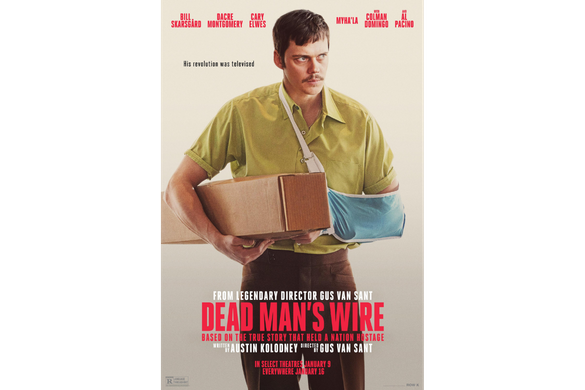
Dead Man’s Wire opens with the kind of premise that seems almost too absurd to be real, which is precisely why it works so well on screen. Gus Van Sant takes this bizarre hostage story and turns it into something more than a tense reconstruction of events. He shapes it into a film about spectacle, resentment, and the dangerous seduction of public attention.
What makes Dead Man’s Wire so compelling is that it never settles into one register. It is tense, yes, but also darkly funny, socially observant, and faintly grotesque. The film understands that the line between tragedy and farce is often very thin, especially in stories shaped by ego, media, and money. Rather than polish the material into a neat thriller, Van Sant lets it stay jagged, uncomfortable, and alive.
What Dead Man’s Wire is about
Set in 1977 and based on a real incident, Dead Man’s Wire follows Tony Kiritsis, a failed real estate dreamer whose anger over a financial collapse pushes him toward an act of public desperation. Convinced he has been cheated and ruined, he stages a hostage crisis that quickly spirals into a national spectacle.
The film is not interested in overexplaining every beat of the standoff. Instead, Dead Man’s Wire uses the incident as an entry point into something larger: a portrait of a man who turns grievance into theater, and of a country eager to watch that theater unfold in real time. What begins as a desperate act of revenge becomes something stranger, sadder, and more revealing.
Dead Man’s Wire: Direction, atmosphere, and storytelling
One of the most impressive things about Dead Man’s Wire is its tonal control. Gus Van Sant directs the film with a sharp instinct for contradiction. The movie moves like a thriller, but it is shot through with satire, dread, and a kind of deadpan disbelief. It never lets the audience get too comfortable in any one emotional response.
The visual atmosphere does a great deal of work here. Dead Man’s Wire captures a beige, bruised, exhausted America, one defined by cold streets, dull offices, local news cameras, and the sense that everything respectable is only barely holding together. The period setting feels lived-in rather than decorative, which gives the film weight. This is not nostalgia. It is social texture.
Van Sant also understands the power of pacing. Dead Man’s Wire is not built like a sleek modern thriller obsessed with relentless momentum. It unfolds with tension, but also with pauses, awkwardness, and strange detours that make the whole ordeal feel more real and more unnerving. The instability becomes part of the storytelling language.
What emerges is a film that sees the hostage crisis not just as a criminal act, but as a performance. In Dead Man’s Wire, television, public opinion, and self-mythology are as important as the gun itself. That insight gives the film its contemporary sting.
Performances and characters
Bill Skarsgård gives Dead Man’s Wire its manic pulse. His performance as Tony Kiritsis is not merely wild or eccentric; it is carefully unbalanced. He plays the character as a man whose desperation has become inseparable from performance. Tony wants revenge, but he also wants to be seen, heard, validated, and mythologized. Skarsgård captures all of that without turning him into a caricature.
What makes the performance land is its volatility. In one moment, Tony is pathetic; in the next, dangerous; then suddenly almost absurd. Dead Man’s Wire depends on that instability, and Skarsgård delivers it with unnerving conviction.
Dacre Montgomery brings a very different energy. His work is quieter, more wounded, and more humane. As the hostage trapped inside Tony’s collapsing logic, he becomes the film’s emotional anchor. Montgomery resists melodrama and instead gives the film something more valuable: believable endurance. In a film full of noise, he gives us the cost of that noise.
Al Pacino appears in a smaller role, but his presence adds a sharp aftertaste. He does not need many scenes to leave a mark. Cary Elwes brings dry intelligence, Colman Domingo adds texture and authority, and Myha’la helps give Dead Man’s Wire its media-world urgency. The supporting cast understands the film’s tonal game and plays into it with precision.
What works and what doesn’t
What works best in Dead Man’s Wire is its refusal to reduce this story to a simple morality play. The film does not ask us to admire its central figure, but it does insist that we understand the ecosystem that allowed him to become a public fascination. That is where the movie becomes richer than a standard true-crime thriller.
The writing and direction are strongest when they expose the strange chemistry between public grievance and public entertainment. Dead Man’s Wire is acutely aware that America often turns instability into celebrity and chaos into narrative. That idea gives the film both its humor and its bite.
The performances are another clear strength, especially Skarsgård and Montgomery, who create a compelling tension between theatrical menace and quiet suffering. Their dynamic keeps Dead Man’s Wire grounded even when the surrounding events veer toward the surreal.
Still, the film is not flawless. Some supporting figures are drawn more as types than as fully layered people, and there are moments when the absurdity threatens to overshadow the human stakes. A few viewers may also find the tonal slipperiness distancing. Dead Man’s Wire does not guide the audience toward one clean emotional response, and that will not work for everyone.
But that messiness is also part of the film’s identity. It is a story about incompetence, ego, spectacle, and national confusion. A cleaner film might have been easier to digest, but it would likely have been less interesting.
Dead Man’s Wire is one of those rare films that treats a bizarre true story not as a gimmick, but as a lens. Gus Van Sant uses the chaos of this hostage crisis to examine something much larger: the American hunger for attention, the theatricality of grievance, and the uneasy overlap between media coverage and public appetite.
That is what makes Dead Man’s Wire more than an efficient thriller. It is a darkly comic, sharply observed piece of cinema that understands how absurdity and violence can live side by side. It does not hit every note with perfect precision, but it is too intelligent, too strange, and too tonally daring to ignore.
For readers looking for a hostage drama with atmosphere, strong performances, and a genuine point of view, Dead Man’s Wire is absolutely worth watching.
Rating: ⭐⭐⭐⭐⭐⭐⭐⭐✩✩ (8.4/10)